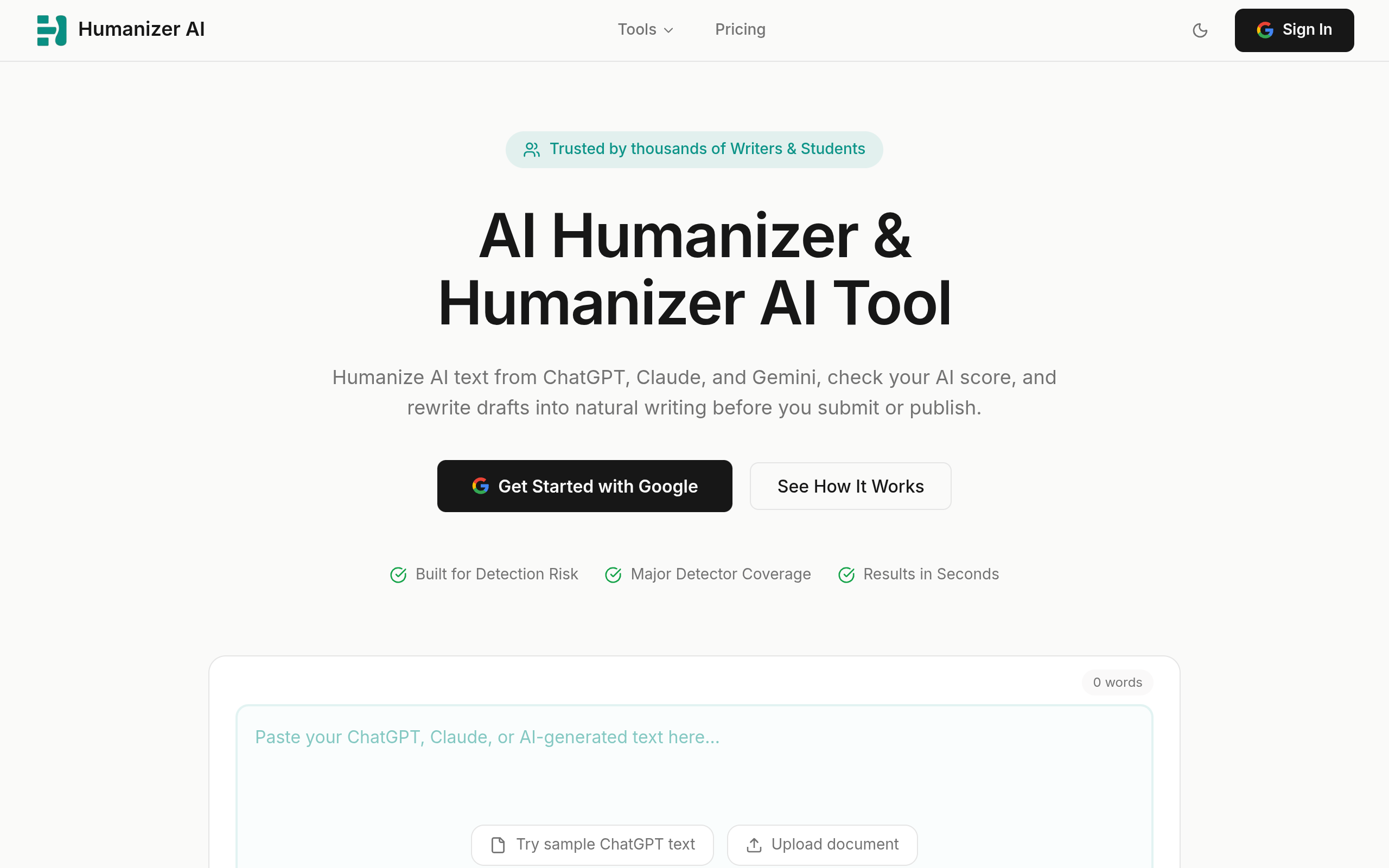
Humanizer AI
MCP server
Humanizer AI is built for people who run their writing through agents, not browser tabs. It's the rare humanizer that ships both an MCP server (on npm) and an AI Agent Skills integration, so you can wire it into Claude with one command and humanize or check text as a tool call. Around that sit a documented REST API with webhooks, three rewrite strengths, document upload and a free, unlimited built-in detector. It's also unusually candid for the category — the vendor flatly says most humanizers exaggerate their bypass rates and publishes its own mid-range numbers instead of a fake 99%. The honesty is refreshing; the evidence is still its own.
Built for agents
The differentiator is integration. Humanizer AI is the only tool here pairing an MCP server with Agent Skills: install the skill with a single /learn command, connect the MCP server from npm, and the humanizer lives inside your agent workflow rather than in a separate window. For developers there's a real REST API — humanize and detect endpoints, webhook support for async jobs, and published rate limits that climb from a few hundred requests a minute to over ten thousand on the top tier. Three modes (Light, Medium, Bypass) set the rewrite strength, and a useful detail for technical writers: quoted text, citations and even LaTeX pass through untouched rather than getting mangled in the rewrite.
What you get
MCP + Agent Skills
The only tool here with both — install via /learn, connect the npm MCP server, use it inside Claude
REST API + webhooks
Humanize and detect endpoints, async webhooks, rate limits up to 10,300/min
Three modes
Light, Medium and Bypass set the rewrite strength to the detector you face
Free detection
Built-in detector, unlimited and free, even without a humanizing plan
Element preservation
Quotes, citations, dialogue and LaTeX pass through untouched
Reach & input
50+ languages, document upload, and a Chrome extension
How it holds up
The bypass numbers are the company's own, but Humanizer AI is more honest about that than most. Its published benchmark averages about 80% across five detectors — GPTZero 83%, ZeroGPT 86%, Turnitin 78%, Originality.ai 74%, Copyleaks 81% — and the vendor explicitly says the category's "99% bypass" claims are exaggerated, putting out those mid-range figures instead. There's still no independent test or community signal to confirm them, so take ~80% as a self-reported-but-plausible ceiling rather than a guarantee. One more thing worth knowing: the privacy policy reveals the text is processed by OpenAI, which means the "proprietary" engine is an orchestration layer on top of OpenAI rather than a model of its own. You're paying for the agent integration and the API, not for a secret model. The free built-in detector is the honest way to check where your output actually lands.
No free humanizing, and a borrowed engine
Two real limits. There's no free humanization — detection is free and unlimited, but rewriting starts at the 10,000-word Starter plan, so you can't try the actual product on real text without paying. And the performance, while candidly reported, is unverified and rests on an OpenAI back end, so for anything high-stakes the built-in detector — not the marketing average — is what to trust. It's a platform priced and built for serious, programmatic use, not a casual paste box.
The verdict
Humanizer AI is the right pick for the agent-driven power user and the developer — anyone who wants humanizing available as a Claude tool call or a webhook-backed API, with rate limits that scale to agency volume. The MCP-plus-Agent-Skills combination is genuinely uncommon, and the element preservation makes it a sound choice for technical and cited writing. It's the wrong pick if you want to test before paying, or if you just need a simple browser humanizer — the value is the integration, not a turnkey rewrite. You're buying the wiring, not a miracle engine — and for a workflow that lives inside an agent, that wiring is genuinely hard to find anywhere else.
Writing
Undetectable
Humanization
Academic