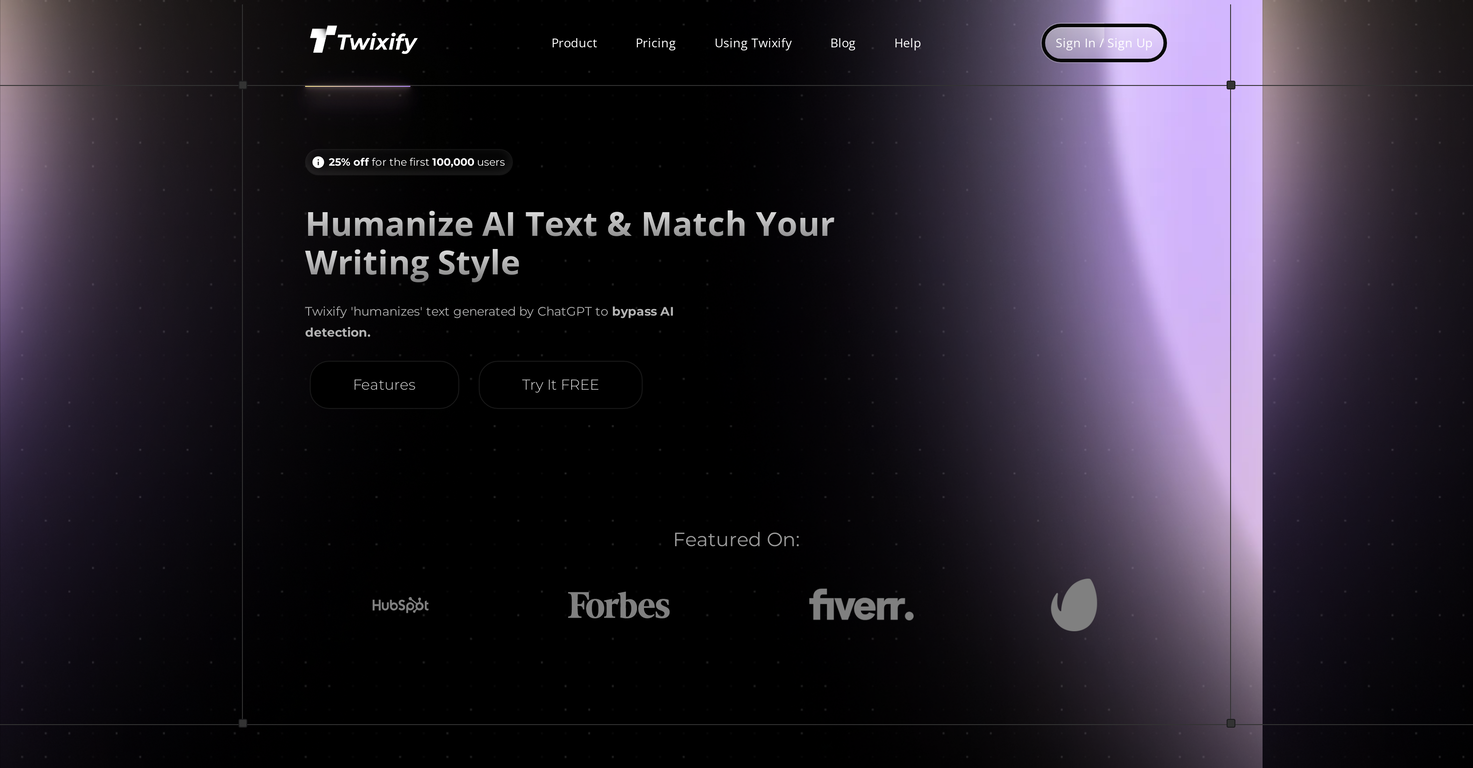
Twixify
Personal Style Mimic
Twixify asks a different question from most humanizers: not "what do you want to hide?" but "who are you?" Its Echowriting feature analyzes samples of your own writing — your sentence structure, vocabulary and tonal quirks — and applies that personal voice profile to AI-generated text, so the output reads like you wrote it rather than like generic "human" prose. Add Knowledge Insertion to keep specific facts intact through the rewrite, a rare lifetime pricing option, and a very low entry price, and it's a genuinely distinctive take. The trade is scope: it's built for short-form, with tight per-cycle word limits.
Your voice, not a generic one
Echowriting is the whole idea. Upload a few hundred words of your own writing and Twixify learns your patterns — in our terms, it picks up the em-dashes and the short sentences and carries that rhythm into the rewrite, instead of swapping synonyms toward a flat average. Voice Profiles let you save multiple styles or pick presets (Empathetic, Direct, Analytical), Knowledge Insertion preserves the facts and figures humanizers often strip, and depth and length sliders tune verbosity. Because the output matches a real person's style, it tends to survive a human read better than a generic rewrite does.
What you get
EchowritingLearns your voice from your own writing and applies it to AI text
Voice ProfilesSave multiple styles, or use presets — Empathetic, Direct, Analytical
Knowledge InsertionKeeps specific facts and data intact through the rewrite
Depth & length slidersTune verbosity and detail level
Lifetime optionA rare one-time-fee plan in a subscription market
Detector coverageClaims effectiveness against the major detectors
How it holds up
The voice cloning is the real draw, and it works as advertised: trained on a sample of your writing, the rewrite adopts your rhythm rather than a generic human one, which is exactly what makes AI output stop reading as AI to a human reviewer. Knowledge Insertion is a thoughtful companion — it keeps the specifics a rewrite would otherwise smooth away. The honest limit is length: the basic plan caps each cycle at a few hundred words, so this is a snippet tool, not a document tool. Chopping a long piece into chunks breaks the flow that makes Echowriting good in the first place. Within its lane, though, it does something most tools don't.
Built for short-form
Twixify fits the writer whose voice is the point. The social media manager keeps a consistent brand voice across LinkedIn and Instagram captions. The personal-brand creator gets one recognizable style across everything they publish. And the short-form writer — emails, captions, intros under a few hundred words — gets exactly the length the tool is tuned for. None of them need a document processor; they need their own voice, reliably, in small pieces.
The verdict
For social media managers and personal-brand creators — anyone whose short-form content has to sound consistently like them — Twixify's Echowriting is a standout idea that delivers, and the low entry price and lifetime option make it easy to try. It's the wrong tool for long-form documents, where the per-cycle word limits force an awkward chop-and-paste. Train it on your best writing first, lean on Knowledge Insertion to keep your facts, and for snippets it does something genuinely its own.
Writing
Undetectable
Humanization